

The United States has a long and storied tradition of civil and civic disobedience. When the colonists felt that they were too onerously taxed, they rebelled. When certain states felt that their interests were no longer represented by the national government, they seceded. When African-Americans perceived themselves as second-class citizens, they marched, held sit-ins, and challenged state and local statutes. The social contract, imagined by John Locke in 1689 and refined in the centuries since, holds that the citizens enter into an agreement with the government for mutual benefit; that contract holds until it is perceived that it no longer serves the interests of the governed. In a similar vein, federalism is an agreement between the various levels of government to work together for the general welfare. When one level of government violates the spirit of that agreement, the others are well within their rights to resist. So it is with sanctuary cities.
The issue of sanctuary cities is an incredibly complex and legally murky one which is at the forefront of the federalist dilemma that Donald Trump’s administration has instigated. Lest you think this issue is confined to certain traditional vanguards of liberalism like California and New York, there are over 400 sanctuary cities and counties across the United States[1] in states as politically and geographically disparate as Georgia, Kansas, Washington, Texas, and Minnesota.
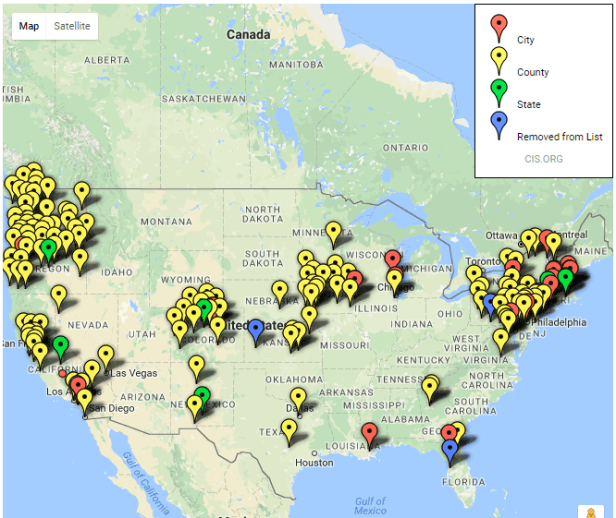
Source: Center for Immigration Studies (map updated March 23, 2017)
Perhaps unsurprisingly, given its political history and diverse and considerable immigrant population, San Francisco is leading the charge to protect the institution of sanctuary cities. The city first passed a law called the “City and County Refuge Ordinance” in 1989 that makes it clear that city officials are not required to cooperate with Immigration and Customs Enforcement (ICE) officials in their attempts to identify and deport illegal aliens in many circumstances. A further city ordinance, passed in 2013, limits the circumstances in which city officials must give ICE advance notice of a particular person’s release from jail.[2] Given its firm stance on the protection of illegal immigrants, the City of San Francisco has brought a lawsuit in federal court against President Trump’s executive order that attempts to force cities to comply with federal immigration policy or face funding cuts or outright freezes. The lawsuit asserts that Trump’s executive order on immigration violates the 10th Amendment, which states that “the powers not delegated to the United States by the Constitution, nor prohibited by it to the States, are reserved to the States respectively, or to the people.” Effectively, San Francisco is claiming federal overreach and that this is a matter that, constitutionally speaking, should be left to the states and municipalities to determine. On Tuesday, a federal judge in California sided with San Francisco, temporarily halting President Trump’s efforts to block funding as a result of the policy of sanctuary cities[3] (at least the ruling didn’t come from “an island in the Pacific”).
The potential impact of this executive order and the subsequent lawsuit affects not only San Francisco but the nation as a whole. In regard to the Golden City, it could potentially lose up to $1.2 billion (13% of the municipal budget) in federal funding for programs related to health care, nutrition, and other programs to benefit the poor.[4] While these cuts would be highly regressive and seemingly draconian, the Trump Administration is on shaky legal ground if it hopes to defund programs not related to law enforcement as a result of the city’s unwillingness to comply with federal agencies like ICE. More broadly, these policies could result in severe distrust between illegal immigrant communities and authorities at all levels. It is likely that various public officials (police, social workers, health workers) would not be involved in disputes, accidents, or illnesses, further compromising at-risk communities. And the people who most need certain services would not have access to them. Furthermore, these immigration provisions, economists have pointed out, could weaken certain industries in terms of a viable labor pool. Agriculture in particular has a huge dependency on migrant labor (sometimes illegal), and entire industries have been damaged by reckless enforcement of overly-stringent immigration laws, including Alabama which lost an estimated $11 billion in tax revenue in 2011 as the result of just such a disastrous policy.[5]
As with any judicial issue, there is legal precedent to consider, and it would seem to be firmly on the side of sanctuary cities. In a 1997 decision on the issue of gun control, the Supreme Court ruled that the federal government could not force states to conduct background checks for handgun purchases. The majority opinion, written by Justice Scalia, held that the federal government could not compel state governments to fulfill its tasks on its behalf.[6] It may seem ironic that a decision indented to repeal gun control could protect illegal immigrants, but the precedent remains and the Court clearly stated that the Necessary and Proper Clause of the Constitution did not give the federal government the right to mandate local policy absent commercial considerations. Adding to the weight of precedent case law, the 2012 Supreme Court decision on the Affordable Care Act found that the federal government could not coerce the states into expanding Medicaid by withholding funding.[7] This ruling fairly clearly establishes that the Trump Administration cannot compel sanctuary states or cities to enact federal immigration laws at the risk of losing funding. As this suit continues to wind its way through the court system (the SF ruling was only a temporary one), the prosecution has several strong precedents to cite from cases that span the political spectrum.
The principal argument against sanctuary cities, and illegal immigration more broadly, is that it abets unlawful, potentially criminal activity and increases the burden on strained social services. To the first argument, President Trump has repeatedly cited a 2015 incident in which an illegal immigrant with prior felony convictions who had previously been deported five times allegedly shot and killed an American citizen in San Francisco.[8] The case gained national attention and was used by candidates in the subsequent 2016 presidential election (mostly notably by our current president) to underscore the need for tougher immigration policies. This episode, while tragic, belies the fact that illegal immigrants are statistically less likely to commit crimes than native-born Americans. Several studies have confirmed this fact,[9][10] and the risk of deportation was not one of the chief deterrent factors, according to the National Bureau of Economic Research. This suggests that a crackdown on illegal immigrants as a solution to reduce crime is merely empty rhetoric and opportunistic scapegoating. Moreover, the argument that it strains social services, while perhaps more convincing, is offset by the fact that illegal immigrants pay an estimated $12 billion in taxes every year. The Institute on Taxation and Economic Policy found that, on average, illegal immigrants pay an estimated total tax rate of 8%, which is higher than the 5.4% of income that the top 1% of taxpayers pay in taxes in a given year.[11] For President Trump and other wealthy Americans to claim that illegal immigrants do not pay their fair share of taxes is not only factually incorrect but also grossly hypocritical, given that many of them are in fact paying taxes at a substantially lower rate than their poorer counterparts.
Beyond the constitutional considerations and the financial ramifications, however, lie the moral arguments. The sanctuary laws around the country were designed to protect the most vulnerable among us from the over-zealous application of immigration law and agencies such as ICE. These local provisions were meant to ensure that illegal immigrants would continue to be able to access vital services, such as the police, health care, and education, without fear of the risk of reporting or deportation. Having an underclass of illegal immigrants, cut off entirely from the services of the state, benefits no one. Yes, we are a country of laws, and those laws should matter. Where illegal immigrants commit serious or violent crimes, they should be and usually are handed over to ICE to face deportation. But we also have to face the reality that the tallest walls or toughest laws will not stop illegal immigration in the face of the massive national wealth imbalances between us and our southern neighbors. If we are to respond to the moral challenge of illegal immigration, we would try to protect the institution of the family, access to vital services, and freedom from undue persecution on behalf of law-abiding residents. This is a more humane path. A path more in keeping with our traditions as a nation that offered sanctuary where needed. And resistance when called upon.
The American experiment was originally established as a sanctuary from religious persecution. Over time, the character and scope of that project have expanded and evolved, but at its core, the idea of America as a land of freedom and of opportunity persists, battered and bruised though it may be. We owe it to our traditions, if not the best version of ourselves, to offer opportunity to those who would take advantage of it and sanctuary to those who seek it.
[1] http://www.latimes.com/local/lanow/la-me-san-francisco-trump-20170131-story.html
[2] http://sfgov.org/oceia/sanctuary-city-ordinance-0
[3] https://www.nytimes.com/2017/04/25/us/judge-blocks-trump-sanctuary-cities.html?_r=0
[4] http://www.latimes.com/local/lanow/la-me-san-francisco-trump-20170131-story.html
[5] https://thinkprogress.org/donald-trump-tried-to-punish-sanctuary-cities-it-s-backfiring-fdb2b8be26fc
[6] https://www.oyez.org/cases/1996/95-1478
[7] http://www.scotusblog.com/2012/06/court-holds-that-states-have-choice-whether-to-join-medicaid-expansion/
[8] http://www.latimes.com/local/california/la-me-immigration-sanctuary-kathryn-steinle-20150723-htmlstory.html
[9] http://www.nber.org/papers/w13229.pdf
[10] https://www.cato.org/blog/immigration-crime-what-research-says
[11] https://www.usnews.com/news/articles/2016-03-01/study-undocumented-immigrants-pay-billions-in-taxes
 Too Many Thoughts, So Little Time