

In recent years during my travels abroad, people often want to talk with me about America and its infatuation with guns. Why do we need so many guns, they ask? Why do mass shootings keep happening at a rate unrivaled in any other developed democracy? And why can we seemingly do nothing about it?
The elusive quest for meaningful gun control continues to vex us, as tragedy follows tragedy and the baffling, maddening inaction on behalf of our political class remains the norm. I felt the same impotence and rage after Sandy Hook, then San Bernardino, and now Stoneman Douglas. What the fuck is wrong with us, I often wonder? And why do none of these avoidable catastrophes incite action as they have in Australia, Norway, and other countries that have suffered mass shootings?
Foreigners are truly baffled both by the proliferation of guns and the inability or unwillingness of our government to do anything about it. Hell, Congress itself won’t even let the CDC study the issue of gun violence to learn more about the problem since the NRA successfully lobbied for the Dickey Amendment in 1996.[1] Never mind that this is the functional equivalent of the fast food industry banning dietary and nutrition research in the midst of an obesity crisis, but it does point to the unwillingness to even entertain explanations of causation and data-driven solutions.[2] So why do Americans cling to their guns despite the numerous international precedents and domestic studies that indicate that stricter gun laws do indeed lead directly to fewer gun deaths?
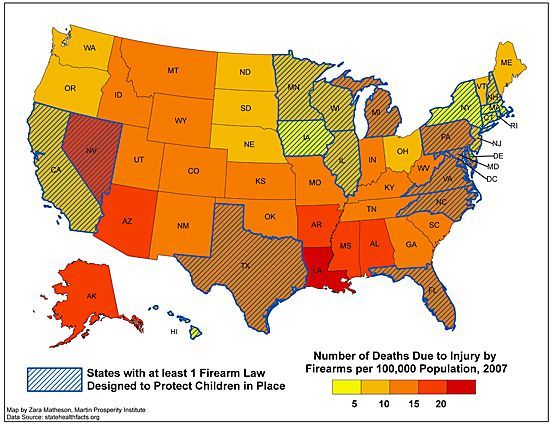
Source: Zara Matheson/Martin Prosperity Institute


Source: Law Center to Prevent Gun Violence
I believe that our unique American infatuation with guns stems from a deep, historic mistrust of government. The right to rebel has evolved as an ingrained part of our identity that stems from the Revolutionary War—the Second Amendment and the need for a ‘well-regulated militia’ itself sprung directly from this conflict. We maintain these ideals in our culture as we celebrate the individual and infuse it with notions patriotism, manifested in our culture by totems such as the New England Patriots, the Philadelphia 76ers, and Sam Adams beer. Even as we have demanded more services and support from our public institutions, we remain fearful of a strong central government that controls us, spies on us, and unduly taxes us. Other countries, like France, have traditions of sedition and resistance as well, but these movements have always been based in popular protest and demonstration. In the US, we reserve the right to rebel, but we believe that this is best protected at the end of a gun. Take away our guns, many Americans feel, and you take away our ability to fight back and therefore the very liberty the Constitution was enshrined to protect. Despite the fact that we now have a standing army to protect us (the largest and most powerful the world has ever seen), thereby obviating the need for the militia the Second Amendment was created to ensure, and that any attempt at rebellion would be easily crushed by the overwhelming advantage of said military, many people still cling to this fanciful notion. At the core of this ideology, however, is again the profound, fundamental mistrust of our government, the depth of which is unique among developed democracies, and it is this dissonance that is at the heart of the inability of the US to move the needle on gun control.
And then there is the complicating issue of identity. Many Americans feel that owning a gun is part of who they are, part of a certain culture that shapes their identity. They are hunters. Or shooters. Or simply men being men, protecting that which is theirs.[3] This is where it gets dicey. Because when issues of identity are involved, rather than beliefs, the debate gets particularly thorny. I was having a discussion on political correctness with a conservative friend of mine last week, and he made the very valid point that we can discuss policy, but when people base their positions on who they are rather than what they believe, the result is polarization and deadlock. It’s also frequently the death of discourse. You might change your beliefs and opinions, but you’re not going to change who you are. And so it is with the gun debate. People are either pro-gun or anti-gun. And if you are squarely in on one of these teams, it becomes harder to compromise on sensible solutions we all might agree on such as background checks, assault weapons bans, and keeping guns out of the hands of violent offenders or the mentally ill.
While the actions we should take to transcend our differences are murky, the consequences of this paralysis are clear. The death tolls not only from mass shootings but individual shooting and suicides continue to mount. The country becomes ever-more polarized as the liberal coastal states enact gun control measures and the rest dig in. And the rest of the world eyes us with puzzled disdain, as they openly wonder whether it’s safe to visit America anymore.[4]
So what can realistically be done and is there any hope for meaningful change? It’s tempting to think that nothing will be done because nothing has been done. With every successive mass shooting and the persistent yet empty calls for thoughts and prayers taking the place of meaningful policy action, it’s very easy to become frustrated and apathetic. But I have to admit to being incredibly encouraged by the actions and words of the Stoneman Douglas students and the reaction it is engendered in the sustained response to this last shooting, be it in social media or by some of the more outspoken political proponents of gun control. What we really need to do is work to oust cowards like Marco Rubio and his ilk who will not budge on sensible gun control issues and stand in the way of science, study, and reform. This means turning out the vote in 2018, electing candidates who are not beholden to the NRA, and passing sensible gun legislation, either at the state or the national level. Once we’ve gotten a fair number of the intransigents out of the way, we should start with national mandatory background checks in all states—a measure that gets an overwhelming amount of support on a bi-partisan basis. On the issue of bump stocks, even the NRA seems on board on this one. And then there is the no-brainer of banning assault weapons such as the AR-15 that are seemingly always used in these shootings. Once we’ve got a baseline of sensible, first-step policies in place, we can start discussing more nuanced policy.
We don’t have to take all Americans’ guns away, even if that’s what I’d prefer. I realize that my views are extreme and not representative of all Americans. Having shot guns at ranges, both as a teenager at summer camp and in qualifying in the Air Force, I know that shooting be can be fun and can be done safely in a controlled environment. But do we really want to preserve the “right” for everyone to have a gun without criteria or limitations, given the clear evidence of the wide-scale death and destruction to our communities that it’s causing? I do get that some Americans feel that guns are somehow a part of their identity, even if I don’t even remotely share this association. Perhaps we need to solidify and reinforce the identity of the gun owner who also supports rational gun control–there are plenty of these people out there. We can also talk about which of the existing proposals make the most sense to directly solve our problems. But we first have to separate the idea that having unfettered access to guns is somehow a necessary part of the American national identity so that we can get to those policies that can change the reality on the ground.
[1] http://theconversation.com/why-is-there-so-little-research-on-guns-in-the-us-6-questions-answered-92163
[2] The general denigration of science and data in the US is another alarming development but a matter for another day.
[3] I do think that there is a decided element of machismo and that the gun industry and gun rights lobby is overwhelmingly driven by men. Again, it’s no coincidence that almost all of these mass shooters are men.
[4] Tourism has in fact declined 6% since 2015 (https://www.bloomberg.com/news/articles/2018-01-17/how-to-reverse-america-s-foreign-tourist-problem), though part of this is undoubtedly the Trump effect and the stink that his administration has put on the country.


I didn’t read the whole thing, but I don’t think America is ‘infatuated’ with guns. I think that’s going overboard. I was impressed with the graphic, but ‘gun death’ certainly does not mean what happened in Florida last week. That would certainly constitute everything, correct? By that I mean gang shootings as we see in Chicago almost every week, people being stupid and shooting themselves or a friend, or yes – people defending themselves.
LikeLike
Hi Ken, thanks for checking out the blog. Infatuation is indeed, as you point out, a strong word. Given the rates of American gun ownership (http://www.bbc.com/news/world-us-canada-41488081) and the amounts by which they exceed the rest of the world, I’d say the shoe fits, but it is certainly a matter of opinion. I’m not sure why the mass shooting at Stoneman Douglas wouldn’t count as gun deaths. I think it certainly qualifies, as do the other incidents you mention. If you read to the end, I try to get at productive ways forward, recognizing that their is a gun culture in America (that I admittedly am not a part of nor do I want to be), but that this should not prevent us from compromising on sensible gun control policy. Hope we can agree on that.
LikeLike